> ## Documentation Index
> Fetch the complete documentation index at: https://starforge.mintlify.site/llms.txt
> Use this file to discover all available pages before exploring further.
# Rubrics
> Your team's written standards for a correct answer, their versions, and who used them.
A rubric is named criteria, weights and a scale — written down, owned, and versioned. This screen is
where most people draft one before moving to the API for later edits.
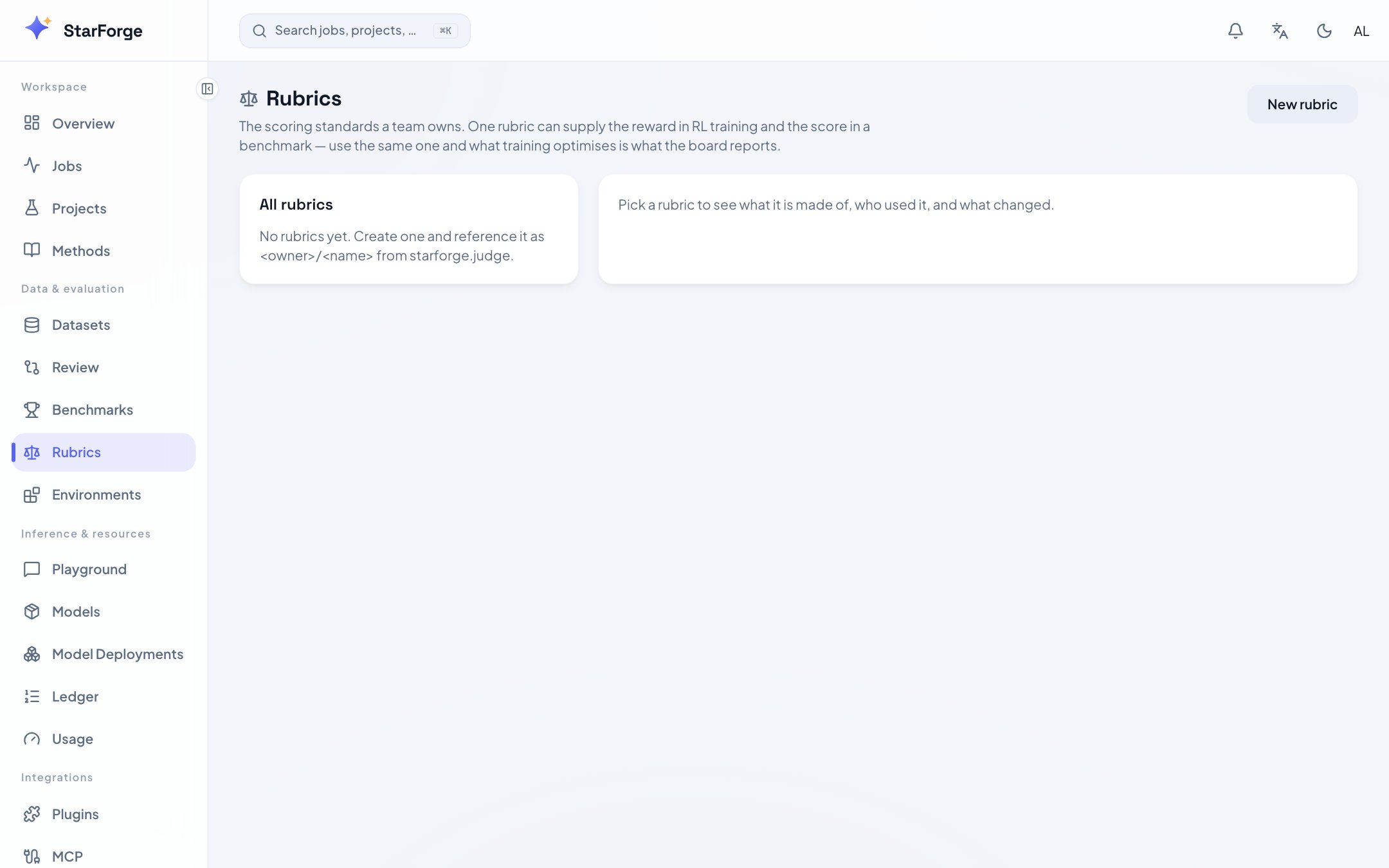 ## What you see
| Region | What it shows |
| -------------- | ------------------------------------------------------------------------------------- |
| **List** | Every rubric you can read: your own, plus public ones |
| **Criteria** | Each criterion's name, weight and description |
| **Version** | The current version number; every edit increments it |
| **Visibility** | Private (you and administrators) or public (everyone reads, you still write) |
| **Revisions** | The full text of every past version |
| **Usage** | Which runs cited which version, and whether as a training reward or a benchmark score |
## What you can do
* **Create** a rubric, with a sample criterion to start from.
* **Edit** one — which creates a new version rather than overwriting the old text.
* **Delete** one you own.
Editing invalidates the judge's cached scores for this rubric, because the cache key carries its
version. That is deliberate: sharpening a criterion should not leave old scores standing as though
nothing changed.
## Where the rubric is actually used
One object, three places — which is the whole reason it is an object rather than a prompt pasted into
two configs:
| Used as | Configured in |
| ------------------- | ------------------------------------------------------------------- |
| A training reward | An [environment verifier](/en/extend/verifiers) with `kind: rubric` |
| A benchmark | A [benchmark pack](/en/extend/benchmark-packs) with `runner: judge` |
| A safety evaluation | A pack with `runner: safety` |
Because it is one object, the standard a model trains against and the standard it is scored against
cannot quietly drift apart. See [writing a rubric](/en/extend/rubrics).
## What you see
| Region | What it shows |
| -------------- | ------------------------------------------------------------------------------------- |
| **List** | Every rubric you can read: your own, plus public ones |
| **Criteria** | Each criterion's name, weight and description |
| **Version** | The current version number; every edit increments it |
| **Visibility** | Private (you and administrators) or public (everyone reads, you still write) |
| **Revisions** | The full text of every past version |
| **Usage** | Which runs cited which version, and whether as a training reward or a benchmark score |
## What you can do
* **Create** a rubric, with a sample criterion to start from.
* **Edit** one — which creates a new version rather than overwriting the old text.
* **Delete** one you own.
Editing invalidates the judge's cached scores for this rubric, because the cache key carries its
version. That is deliberate: sharpening a criterion should not leave old scores standing as though
nothing changed.
## Where the rubric is actually used
One object, three places — which is the whole reason it is an object rather than a prompt pasted into
two configs:
| Used as | Configured in |
| ------------------- | ------------------------------------------------------------------- |
| A training reward | An [environment verifier](/en/extend/verifiers) with `kind: rubric` |
| A benchmark | A [benchmark pack](/en/extend/benchmark-packs) with `runner: judge` |
| A safety evaluation | A pack with `runner: safety` |
Because it is one object, the standard a model trains against and the standard it is scored against
cannot quietly drift apart. See [writing a rubric](/en/extend/rubrics).