> ## Documentation Index
> Fetch the complete documentation index at: https://starforge.mintlify.site/llms.txt
> Use this file to discover all available pages before exploring further.
# Run a benchmark
> Score a finished run against GSM8K, MMLU, C-Eval and the rest, on one comparable dashboard.
```bash theme={"theme":{"light":"github-light","dark":"github-dark-dimmed"}}
sf new my-bench --method evalkit/benchmark # once per project
sf bench run my-bench -m run:run-4f2a91 --suites gsm8k,mmlu
```
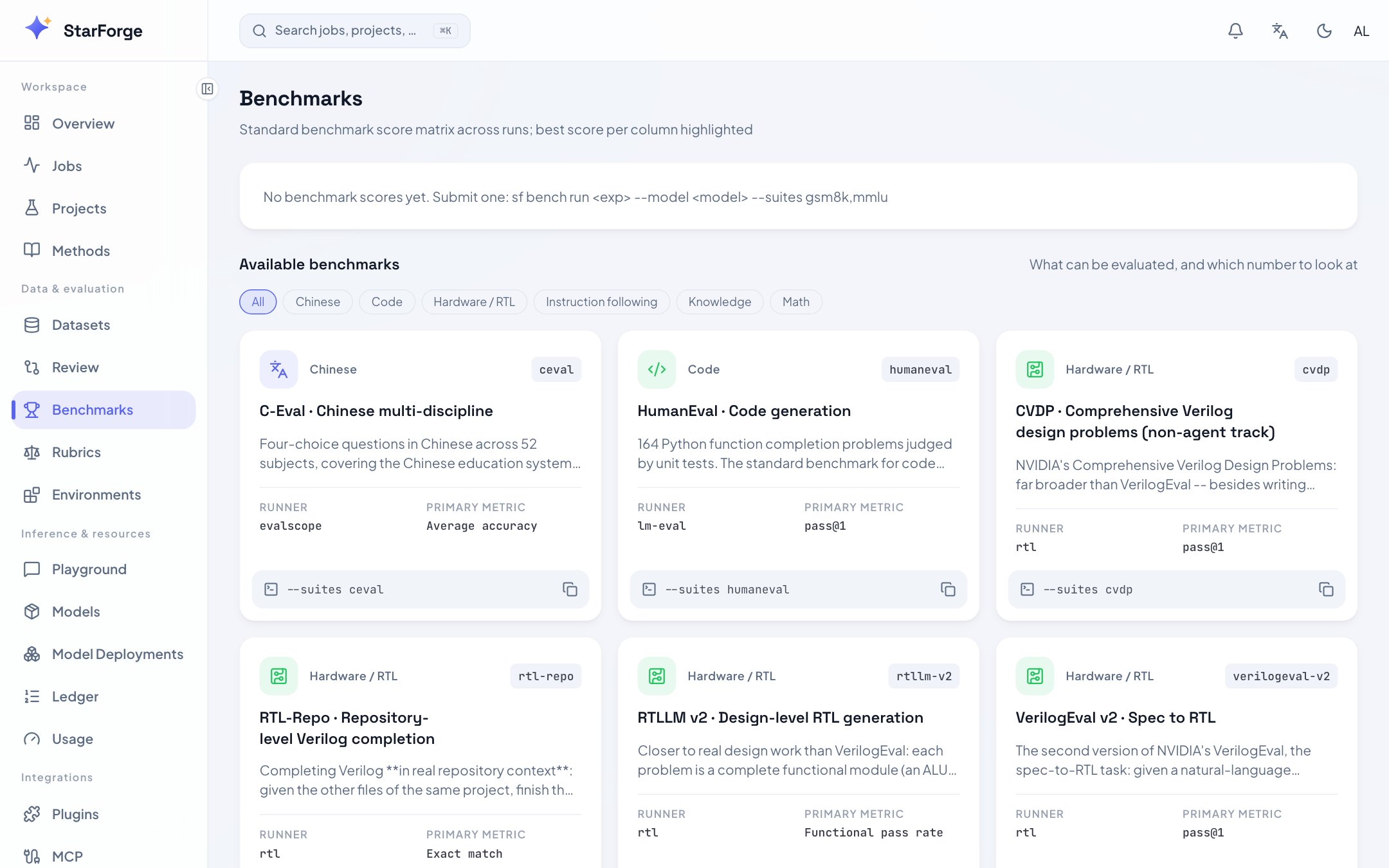
Scores land on the console's Benchmarks page, in the same matrix as every other run — comparable
across runs, methods and base models.
 ## What you can score
| `-m` accepts | Example |
| ------------------------ | --------------------------------------------------------------------- |
| A run | `run:run-4f2a91` — resolves that run's exported weights automatically |
| A Hub model | `Qwen/Qwen2.5-7B` |
| A path on shared storage | `/mnt/shared/models/qwen-support-v3` |
Scoring a run requires it to have been exported. `--then export` at submission time saves you
remembering.
## Which benchmarks are available
```bash theme={"theme":{"light":"github-light","dark":"github-dark-dimmed"}}
sf bench ls
```
Built in: `gsm8k`, `math`, `humaneval`, `mmlu`, `ceval`, `ifeval`, plus the RTL packs. Anything
published as a [benchmark pack](/en/extend/benchmark-packs) appears here too.
Those axes are chosen deliberately — math, code, knowledge, Chinese, instruction following. Post-
training reliably improves one and quietly damages another, and running several is what makes that
visible before it reaches production rather than after.
## Common options
| Flag | Use it for |
| -------------- | ------------------------------------------------------------------------------ |
| `--suites` | Comma-separated benchmark names |
| `--runner` | `lm-eval` (default) or `evalscope`, which covers Chinese benchmarks better |
| `--limit` | Cap samples per benchmark. Smoke tests only — never for a score you will quote |
| `--profile` | Resources, exactly as for training |
| `--extra-args` | Passed through to the runner |
A `--limit` score is not comparable with a full one, and nothing downstream marks it as truncated.
Use it to check that the pipeline works, then run without it.
Both runners produce the **same score contract**, so the same benchmark is directly comparable
whichever ran it. The choice of runner does not distort the number.
## Score every run automatically
Running it by hand is fine once. Making it happen on every run is what stops a regression reaching
production:
```bash theme={"theme":{"light":"github-light","dark":"github-dark-dimmed"}}
sf submit my-grpo --profile h200:8 --then eval
```
Or declare an evaluation gate in the experiment config, so a run that falls below a threshold is
marked as failing its gate — see the `eval:` block in your method's template.
## Reading the matrix
Scores are ingested idempotently: re-reporting the same run and benchmark updates the row rather
than adding a second one.
Each metric carries a declared direction, so the comparison view knows which way is better without
guessing. Where a benchmark declares more than one metric, the difference between them is often the
useful part — GSM8K's strict and flexible matches diverging means the model can do the arithmetic
but is not formatting the answer as asked.
## Scoring outside the platform
When the harness cannot run here — a licensed tool, a physical test rig — report the numbers back
instead:
```bash theme={"theme":{"light":"github-light","dark":"github-dark-dimmed"}}
sf bench external create -m run:run-4f2a91 --harness cvdp --train-run run-4f2a91
sf bench external submit --file scores.json
```
`create` returns a run id; `submit` reports the score file against it. `--train-run` is what lets
the evaluation gate and the model version accept these scores — without it they are recorded but
not authoritative.
They enter the same matrix, labelled as externally produced.
## Confirm it worked
```bash theme={"theme":{"light":"github-light","dark":"github-dark-dimmed"}}
sf job ls # the benchmark job, like any other
sf job logs
```
Then open the Benchmarks page. A row for your run with a score in each requested column means it
worked. An empty column means that suite failed — the job log names which.
## Next
Declare your own evaluation set: what to run, and which numbers to read.
Score what a rule cannot, with an LLM judge against a written standard.
## What you can score
| `-m` accepts | Example |
| ------------------------ | --------------------------------------------------------------------- |
| A run | `run:run-4f2a91` — resolves that run's exported weights automatically |
| A Hub model | `Qwen/Qwen2.5-7B` |
| A path on shared storage | `/mnt/shared/models/qwen-support-v3` |
Scoring a run requires it to have been exported. `--then export` at submission time saves you
remembering.
## Which benchmarks are available
```bash theme={"theme":{"light":"github-light","dark":"github-dark-dimmed"}}
sf bench ls
```
Built in: `gsm8k`, `math`, `humaneval`, `mmlu`, `ceval`, `ifeval`, plus the RTL packs. Anything
published as a [benchmark pack](/en/extend/benchmark-packs) appears here too.
Those axes are chosen deliberately — math, code, knowledge, Chinese, instruction following. Post-
training reliably improves one and quietly damages another, and running several is what makes that
visible before it reaches production rather than after.
## Common options
| Flag | Use it for |
| -------------- | ------------------------------------------------------------------------------ |
| `--suites` | Comma-separated benchmark names |
| `--runner` | `lm-eval` (default) or `evalscope`, which covers Chinese benchmarks better |
| `--limit` | Cap samples per benchmark. Smoke tests only — never for a score you will quote |
| `--profile` | Resources, exactly as for training |
| `--extra-args` | Passed through to the runner |
A `--limit` score is not comparable with a full one, and nothing downstream marks it as truncated.
Use it to check that the pipeline works, then run without it.
Both runners produce the **same score contract**, so the same benchmark is directly comparable
whichever ran it. The choice of runner does not distort the number.
## Score every run automatically
Running it by hand is fine once. Making it happen on every run is what stops a regression reaching
production:
```bash theme={"theme":{"light":"github-light","dark":"github-dark-dimmed"}}
sf submit my-grpo --profile h200:8 --then eval
```
Or declare an evaluation gate in the experiment config, so a run that falls below a threshold is
marked as failing its gate — see the `eval:` block in your method's template.
## Reading the matrix
Scores are ingested idempotently: re-reporting the same run and benchmark updates the row rather
than adding a second one.
Each metric carries a declared direction, so the comparison view knows which way is better without
guessing. Where a benchmark declares more than one metric, the difference between them is often the
useful part — GSM8K's strict and flexible matches diverging means the model can do the arithmetic
but is not formatting the answer as asked.
## Scoring outside the platform
When the harness cannot run here — a licensed tool, a physical test rig — report the numbers back
instead:
```bash theme={"theme":{"light":"github-light","dark":"github-dark-dimmed"}}
sf bench external create -m run:run-4f2a91 --harness cvdp --train-run run-4f2a91
sf bench external submit --file scores.json
```
`create` returns a run id; `submit` reports the score file against it. `--train-run` is what lets
the evaluation gate and the model version accept these scores — without it they are recorded but
not authoritative.
They enter the same matrix, labelled as externally produced.
## Confirm it worked
```bash theme={"theme":{"light":"github-light","dark":"github-dark-dimmed"}}
sf job ls # the benchmark job, like any other
sf job logs
```
Then open the Benchmarks page. A row for your run with a score in each requested column means it
worked. An empty column means that suite failed — the job log names which.
## Next
Declare your own evaluation set: what to run, and which numbers to read.
Score what a rule cannot, with an LLM judge against a written standard.